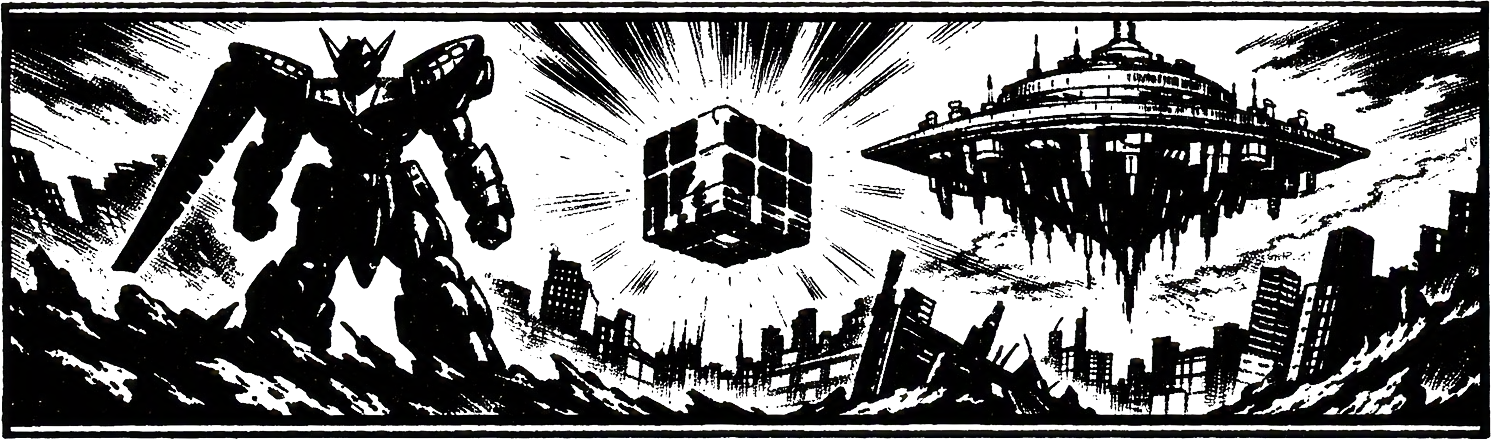
Katsura Hashino meant it as the highest compliment he had. He had directed Persona 3, 4, and 5, he had built a studio to chase the games he wanted to make, and sitting across from Tetsuya Takahashi in early 2018 he reached for the biggest word in his vocabulary to describe the second half of Xenogears. He called it an aesthetic of omission. A deliberate act of leaving-out so bold that no one else in the industry would have dared it. Then Takahashi corrected him, and the correction is the most honest thing anyone has ever said about how this kind of work actually gets made.
The second half of Xenogears is the most argued-over stretch of any Square RPG. For twenty years the story about it was simple and slightly sad: Square ran out of money, the team ran out of time, and a masterpiece limped across the finish line held together with tape. What Takahashi has actually said, in two separate interviews that almost nobody has read side by side, is stranger and better than that. This is the whole of it — the compliment, the correction, the two different deadlines he has described, and the evidence the game keeps on itself.
The Compliment That Missed
Hashino opened as a fan, not a peer. He told Takahashi that plenty of the staff on his own team were Xenogears devotees, that he had been nervous about the meeting, that he only learned during the conversation that the Xenoblade games descend from Xenogears at all — the three had always read as that different to him. This is worth holding onto, because the exchange that follows only works if you understand that the man delivering the compliment is sincere. He is not needling. He is trying to give a game he loves the most serious reading he can.
And the reading he gives is the one almost everyone gives. Xenogears shipped in 1998 on two discs, and where the first is a sprawling role-playing game full of towns and dungeons and cutscenes, the second stops handing you a world to walk through. It sits you down and narrates the ending instead — characters in a spare room, recounting the events of a climax while the game shows you fragments. Hashino was floored by it. Normally you can't do that, he said. To find someone doing it inside an industry that size, at a company the size of Square, put the game on a different layer from everything around it. He called the choice an aesthetic of omission, then immediately worried aloud that the phrase might be rude.
It's a generous instinct, and it points at something real. But it also quietly assumes the leaving-out was a taste — a thing chosen for how it would feel, the way a painter decides how much of a face to imply. That assumption is worth pausing on, because the language the Japanese audience uses for the same stretch of game tells you the choice was under a lot more pressure than “taste” allows.
English coverage reaches for technology when it describes the second half — slideshow, PowerPoint, text dump. The standard Japanese pejorative reaches for something older. It names a form of street-corner theatre, the kind where a narrator stands beside a stack of illustrated boards, flips them one at a time, and speaks the whole story aloud to whoever has stopped to watch. The insult is real, and it stings for the same reason: too much telling, too little happening. But it accuses the game of something different. Not of being broken software — of being a performance held in the wrong hands, a story that had to be recited because there was no time left to stage it.
That's the frame Takahashi was handed: a generous compliment resting on the idea that the recitation was a design. His answer took the compliment apart in a single clause.
Two Deadlines, Two Stories
He said it wasn't an aesthetic. He said it was a fistfight — and then, with a laugh, named the feeling underneath it: an absolute refusal to lose. That's the line, and stripped of everything around it, it reads like bravado. It isn't. It's the most compressed possible account of what the second half actually was, and Takahashi spends the rest of the conversation unpacking it into a sequence of specific, unglamorous facts.
It wasn't an aesthetic. It was a fistfight — the feeling of “I absolutely will not lose.” — Tetsuya Takahashi
Here is the version he gave in that 2018 conversation. Square at the time held every project to an eighteen-month schedule. Xenogears did not fit in eighteen months, and Takahashi pleaded his way to two years. Even at two years, it became clear the team would not finish. So the order came down from above: cut it off somewhere convenient, wherever the game happened to be. And cutting it there, Takahashi said, would mean the thing genuinely disappears — not a shortened game but a vanished one. What shipped was the answer he squeezed out of that corner. If they had simply kept building it out the normal way, he added, it might have ended up merely additive — one more thing, then another, then another. Doing it today, he said, would absolutely not be allowed. It was the era that let him get away with it.
Now here is the version he gave eight months earlier, at a trade show in Los Angeles, through a translator, to a Western outlet asking the same question for the first time in nineteen years. The project, he said, was staffed almost entirely with new, young people. The standing rule was that all projects take two years, full stop. On top of building the game they had to train the staff building it, and 3D was so new that the schedule slipped, and finishing everything simply wasn't possible. Square's higher-ups suggested ending the game after the first half — right at the escape from Solaris. He thought that ending was too rough, that players wouldn't accept it, so he proposed the narrated second half as the way to reach the real ending inside the staff, schedule, and budget he had left. He thinks it was the right call. Ending halfway would have been bad.
Read them together and they don't contradict each other on a single fact. The team was young, 3D was new, the schedule broke, management wanted to stop early, Takahashi refused and countered, the counter shipped. But they are not the same story, because they disagree about what kind of story it is.
In English, the two years is a normal allowance the team failed to hit. The tone is circumstantial — young staff, hard technology, an honest shortfall. In Japanese, the two years is itself a prize he had already won by arguing, wrung out of a company that only gave anyone eighteen months. The failure isn't against a generous deadline; it's against a deadline he'd already bent past breaking. One account foregrounds circumstance. The other foregrounds conflict. Same man, same events, eight months apart — and only one of them sounds like a fistfight, because only one of them remembers the fight that came before the deadline was even set.
The Game Keeps Its Own Records
Count the chapters and the fight is visible. You don't have to take Takahashi's word for any of this, because Xenogears keeps its own books. Every time you save at a memory cube, the game assigns the story a subtitle — a little chapter heading, the way a novel names its chapters or an anime names its episodes. It's a running ledger of the game's own structure, written by the game as you play it. And the ledger does not balance.
The first half carries fifty-one of these chapter subtitles. The second half carries eleven — and two of those eleven are a single narration sequence long enough that the game splits its title into a first and second part, so on a clean count it's really ten. Sixty-two markers across the whole game, and more than eighty percent of them fall before the halfway point.
The shape of the subtitles changes too, not just the count. The first half's are anchored to places and events — a village, a desert city, a sealed gate, a captured ship, a descent into ruins. They name things you do and rooms you stand in. The second half's turn abstract and cosmological, because the locations stop being places you walk through and start being ideas the narration hands you. The ledger doesn't just show the compression. It shows the exact moment the game stops being a place and becomes a recitation.
On a replay, watch the subtitle that appears each time you save. For most of the game they arrive every twenty or thirty minutes, thick and frequent, each one naming somewhere new. Then, right after the escape from Solaris, they thin out and stretch. The gap between chapter headings is the schedule made visible — you are literally watching the calendar run out, one save screen at a time.
What got compressed was not filler. The subtitles are the surviving skeleton of a story that was built to be enormous. The ending screen displays the words Episode V, and that number is not decoration: the official setting book lays out a three-part, six-episode structure spanning roughly fifteen thousand years, of which the game you can buy is the fifth chapter and the only one that exists.
The Japanese read of the result is warmer than the English one. The argument made there is that the narrated second half is an anime-style presentation at heart — talking heads and montage carrying a climax — and that this is a mode a modern audience would accept without blinking. In 1998 it simply arrived before the audience that would have understood it. The Japanese framing isn't “botched.” It's “early.”
| Episode | What it covers | Status |
|---|---|---|
| Episode I | The interstellar war era | Unmade |
| Episode II | The primordial era, 10,000 years before | Unmade |
| Episode III | The Zeboim civilisation, 4,000 years before | Unmade |
| Episode IV | The Solaris war, 500 years before | Unmade |
| Episode V | Fei and the fall of Deus — the game that shipped | Released, 1998 |
| Episode VI | A period after the game | Unmade |
A sequel would have greenlit the rest, and a sequel needed a million copies. Xenogears sold 891,675 in its first year at home — 108,325 short. By several accounts the resources that might have closed that gap were already elsewhere, pulled toward the Final Fantasy film. The fistfight ended in a draw: the game got finished, and the world it was the fifth-sixth of never got built.
Twenty Years of the Same Verb
The fistfight wasn't a metaphor he used once. Later in the same 2018 conversation, asked what he had been like in his Square years, Takahashi didn't hedge: he was combative. He picked fights constantly. He would storm into his superior's office shouting. He said, plainly, that if he behaved that way now his staff would quit and it would count as harassment — and that back then it was simply how he worked. Ask him what he was fighting for, and the answer is always the same three words: he wanted to build a world.
That verb runs through everything he says about himself. He worked on Final Fantasy VII partway before concluding you couldn't express a world through its pre-rendered backdrops, so he peeled off and swung the other way, entirely into 3D. When he arrived at Square from Nihon Falcom, his first thought was that they couldn't win with the visuals they had. Falcom sold on visuals; Square sold on story; he walked in wanting to beat one with the other, and Hironobu Sakaguchi let him try. Cannot win. Will not lose. Picked fights. Stormed in. The fistfight line isn't a colorful one-off — it's the native vocabulary of a man who has described his entire creative life as a series of things he refused to be beaten by.
Twenty years on, he told Hashino he'd gone soft since his kid was born, and that he doesn't much like that about himself. He wants to make something sharp again and finds himself braking. He runs on negative energy, he said — praise kills his motivation; being told he's strange, that nobody can tell what he's thinking, is what powers him. Hashino heard all this and named it: a rebel, then, after all, and that defiance is your real strength. The thing worth sitting with is that Hashino was, in a sense, still right the first time. There is an aesthetic here. It's just downstream of the fight rather than a substitute for it — the shape a refusal takes once it's forced through a wall.
Which leaves the question the whole exchange is really about, and it's a bigger one than Xenogears. When we look at some bold, singular thing an artist made and call it vision, how often are we looking at someone who simply would not be beaten by a schedule? The narrated second half is the cleanest test case there is, because its own author has told us, twice, that it was both — a form he chose and a scope he was forced into, welded together under pressure until you can't see the seam. Hashino looked at the weld and saw craft. Takahashi looked at it and remembered the fight. Both of them are describing the same object. The unsettling possibility is that, for a great deal of the work we admire, there was never any difference between the two.
Common Questions
What did Takahashi actually say about Xenogears' second half?
In a 2018 conversation, the Persona director Katsura Hashino praised the narrated second half as an aesthetic of omission. Takahashi corrected him on the spot: it wasn't an aesthetic, it was a fistfight, driven by the feeling of “I absolutely will not lose.” He meant that the form came out of a schedule war he refused to lose, not out of a taste for leaving things out.
Did Square really run out of money?
No. The constraint Takahashi describes is schedule and staffing, not budget. The team was young and had to be trained while it worked, 3D was new, and the schedule broke — and when he proposed the narrated second half, he specifically pitched it as the way to finish within the staff, time, and budget he already had. Money being held constant is the detail that kills the money theory. The sequel that never came is a separate story, tied to resources going toward the Final Fantasy film.
Was ending the game halfway ever really on the table?
Yes. Square's management proposed stopping the game at the escape from Solaris — the exact point where the first half ends. Takahashi thought that ending was too rough and that players wouldn't accept it, so he countered with the narrated second half as a way to reach the real ending inside the schedule he had left. The version that shipped is the counter-proposal, not the cut management wanted.
Is the second half unfinished, or is it deliberate?
Both, and they're different halves of the same decision. The scope was forced — there was no time to build the ending out as a playable stretch the size of the first half. But the form was chosen: Takahashi decided that narrating the ending was better than cutting it off early, and he still calls that the right call. So the recitation is deliberate; its having to be a recitation is not.
Will Takahashi ever finish the story?
Xenogears shipped as Episode V of a planned six. Asked directly about the rest, Takahashi has said only that he wants to give an answer while he's still alive. That's the whole of what's known — no announced project, no promised remake. The intention is on record; nothing more concrete is.