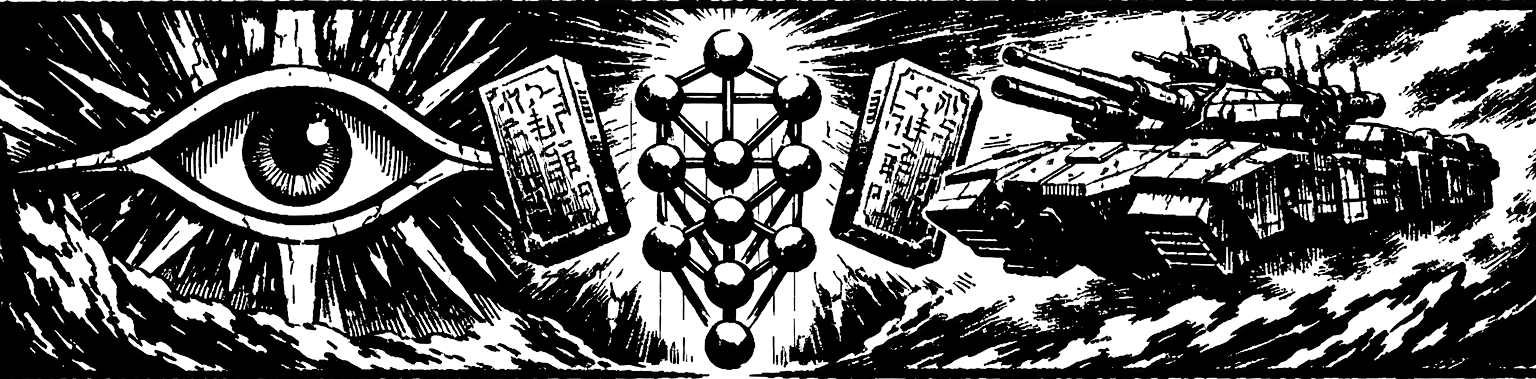
The Zohar is a real book. It was written around 1275, mostly in Aramaic, and the oldest layer of it contains a commentary on the chariot from the Book of Ezekiel. That chariot is called the Merkabah. Xenogears took both names, dropped them into the same weapon system, and never mentioned they came from the same place.
The Kabbalah in Xenogears is not set dressing, and it is not reader pattern-matching either. What follows is every borrowing that carries weight: what each word meant before Square got hold of it, and what the game built out of it.
The Kabbalah in Xenogears Is Not a Coincidence
The game tells you itself. Xenogears' own setting material states that many of its terms derive from Hebrew, from Israeli place names, and from Jewish custom. That is a design note, not a theory — and once the makers have told you the names are load-bearing, working out what they carry stops being speculation.
This piece discusses the ending in full. If you are mid-playthrough, come back after.
Four borrowings do the heavy lifting, and they sit together rather than scattered about. The Zohar, the Merkava, Kadomony and the Path of Sephirot all belong to one object: the weapon system the plot exists to reassemble, powered by a god named Deus — Latin for God, about as unsubtle as a final boss gets.
| Term | In the tradition | In Xenogears |
|---|---|---|
| Zohar | A 13th-century book of mystical commentary | The engine that powers every Gear |
| Merkava | The chariot of Ezekiel's vision | An 80km battleship with a planet-killing cannon |
| Kadomony | Adam Kadmon, the primordial man | A biological computer in the Zohar's eye |
| Razael's Tree | The angel Raziel's book of secret wisdom | A database held in two golden tablets |
| Elehaym | Elohim, a name of God | The woman the Contact keeps being reborn beside |
| Path of Sephirot | The route of emanation back to God | The route out of the world |
It was going to be less subtle. During development the team meant to name him Yahweh outright, and the localiser talked them down. One instance of the earlier name survived the edit at Razael's Tree.
None of it is buried. The line repeating over the opening comes straight out of Genesis.
You shall be as gods. — Genesis 3:5, and the first words of Xenogears
Earth is Lost Jerusalem. Humanity fled to Neo Jerusalem and dates its calendar T.C., for Transcend Christ. Not every religious reference in Xenogears is Jewish — Aeon and Diabolos are Greek, Yggdrasil Norse, Ahnenerbe German — but the Hebrew layer holds the structure up.
The Zohar Is a Book
It has a date on it. The Zohar was composed around 1275, and presents itself as a record of conversations Rabbi Shimon ben Yohai held with his students in second-century Palestine — eleven hundred years between the speakers and the writing. Authorship goes to Moses de Leon, though Gershom Scholem's reading, the one most scholarship works from, is that it compiles works written across many years.
Its title means the Book of Radiance. Partly Hebrew, mostly Aramaic, it is built as a midrash — a running commentary — on the Torah, on Ruth and on the Song of Songs. The manuscripts surfaced in Catalonia between 1280 and 1286, and the 1953 Jerusalem printing runs to twenty-three documents in three strata.
There is a small joke buried in it. The Zohar refers to the Sefirot on almost every page and hardly ever uses the word. The book that fixed the term in place spends its length talking past it.
What Xenogears makes of it is a battery. The Zohar Modifier produces unlimited energy, powers Deus and nearly every Gear on the planet, and is the source of every Ether ability in the game. Its function has a name, the Phenomenon Phase Shift: it realises the most favourable available outcome of any event for whoever holds the controls. Only two people survive prolonged contact with it — Fei, the Contact, and Elly, the Antitype.
A book of commentary became a power source. Hold onto those three strata. The bottom one matters shortly.
The Merkava Is Ezekiel's Chariot
Ezekiel saw it first. The Merkabah appears in the Book of Ezekiel at chapter one and again at chapter ten: a chariot with four wings and four faces — a man, a lion, an ox, an eagle. Three names attach to it: chariot of God, chariot of heaven, and the holy throne of God. Xenogears uses the middle one, the mildest.
What grew out of the vision is what the gloss leaves out. Merkabah mysticism is a practice, not an image: the practitioner enters a meditative state and attempts to board the chariot and reach God directly, passing through the veil around the throne. Amulets, incantations, angels riding along to stop demons defiling the soul in transit. It demands purity of spirit, and the tradition is blunt about the risk.
The Merkava in Xenogears is eighty kilometres across, mothership of the Deus system, hull slits packed with Seraph Angels. Its cannon vaporises any substance it hits, behind a barrier that nullifies anything fired back — a barrier that opens for two seconds each time the cannon fires, which is the only reason the thing can be beaten. Krelian rebuilds it from data held in Razael's Tree.
The reversal is the sharpest thing the game does with any of it. In the tradition, the chariot is what a person climbs into to approach God, at real risk, if they are pure enough to survive the trip. In Xenogears it is a gun platform carrying a god down onto everybody else. Same vehicle, opposite direction.
And it did not come off a different shelf from the Zohar. That commentary sitting in the Zohar's base stratum — the oldest layer, the part Scholem treats as the book proper — is a commentary on Ezekiel's chariot. Xenogears took two parts of one book and bolted them into the same machine.
Kadomony Is the Primordial Man
Kadomony is a respelling. Behind it sits Kadmoni, from Ha-Adam Ha-Kadmoni; Adam Kadmon means Primordial Man. He is not the Adam of Eden. That Adam is Ha-Rishon, the first — this one is Ha-Kadmoni, the original, which is a different claim altogether.
In the Zohar he appears as the primordial supreme man; the name Adam Kadmon turns up in Tikkunei ha-Zohar. Isaac Luria, writing in the 1570s, made him the first thing to exist after the tzimtzum — the contraction God performs to leave room for anything that is not God. Light with no vessel to hold it.
Luria and his student Hayyim Vital get specific about what happens next. The Sefirot and the worlds they compose emanate from the openings in Adam Kadmon's head: ear, nose, mouth, eyes. The lights that flashed from the eyes and mouth were the ten Sefirot and the twenty-two Hebrew letters. Creation comes out of the primordial man's face.
Kadomony in Xenogears is a biological supercomputer built to run the Deus system, installed inside the Zohar's eye. The Zohar has no will of its own, so Kadomony reads intent and relays it. Its capacity to make living things is where every human on the planet came from. Its interior splits three ways.
So: in the tradition, creation pours out of the primordial man's eyes. In Xenogears, the machine named after him is bolted into an eye, and every living thing on the planet comes out of it.
The etymology is documented outright. The eye is the part that gets walked past, and it is what tells you the naming was done by someone who read the material rather than skimming a glossary.
The One Borrowing That Kept Its Meaning
This one still works. The Sefirot are ten, and the earliest reference to them sits in Sefer Yetzirah, the Book of Formation, which counts them without naming them. Names arrived with the Zohar: Keter, crown; Hokhmah, wisdom; Binah, understanding, and the rest. For how they come to exist the Zohar reaches for an optical image — as light radiates from the sun, what flows out of Ein Sof, the infinite and unknowable God, is the Sefirot.
What gets missed about the tree is that it is a route. These are not divine attributes charted on a wall; they are the order in which the infinite becomes finite, which makes them the way back up as well as down. A complete human being, in this account, is one made of all ten.
Now the game. The Zohar was asked to produce an event of zero probability. It answered by tilting possible events further and further out of true until it opened a contact point onto a higher dimension — one holding time from beginning to end — and drew a wave down through the gap. Xenogears calls that point the Path of Sephirot.
Of every borrowing in the game, this is the one carried over with its sense intact. A route aiming at union with the source is what emanation describes, and what Xenogears builds. The other names were repurposed; this one was used correctly.
He does climb it. In the game's last minutes, after everything else has come apart, Krelian follows the Wave Existence up the Path of Sephirot and out of the world. He is the only one who makes that ascent, and here is the part that unsettles me — he gets what he was after. The man who spent five hundred years deciding that if there were no God he would build one is the one person who gets there.
Every other borrowing here was converted into hardware. This one stayed a road, and the game runs a character up it. That is the exception telling you the rest was deliberate — nobody accidentally keeps one term intact while turning five others into machinery.
The Hebrew Hiding in the Map
Three nations are months. Nisan, Kislev and Shevat all appear on the Hebrew calendar — Nisan, Iyar, Sivan, Tammuz, Av, Elul, Tishrei, Heshvan, Kislev, Tevet, Shevat, Adar — names that are Babylonian, adopted during the exile in the sixth century BCE. You spend eighty hours crossing a map whose borders are drawn on a calendar.
The twelve Anima Relics are named Dan, Joseph, Gad, Asher, Zebulun, Judah, Dinah, Reuben, Simeon, Levi, Issachar and Naphtali — the children of Jacob, which is the usual reading and correct as far as it goes. Set them against the twelve tribes and one name is wrong. Benjamin is missing. Dinah stands where he should be: Jacob's daughter, never a tribe.
The substitution is not random. Dinah is the Relic aligned with Sophia and later with Elly — the female line the whole reincarnation plot runs along. The one name swapped out of the list of sons is the one the game needed to be a daughter.
The rest of the map reads the same way. Razael's Tree is the Book of Raziel the Angel, a Kabbalistic text said to carry the secret wisdom given to Adam; in the game it is two golden tablets hovering above the ground, revealed to be a database. Mahanon, the sunken piece of the Eldridge holding it, is named for Mahanaim, where Jacob meets angels.
Zeboim was a city destroyed alongside Sodom and Gomorrah; here it is the civilisation wiped out four thousand years before the story. Even the Japanese term for an Omnigear is built on bara, the Hebrew verb for making something out of nothing — the verb in the first line of Genesis, with the divine El- prefix on several names for good measure.
Put the pattern together and it is hard to miss, easy to have walked past. A book became an engine. A vision became a warship. The primordial man became a computer in an eye socket, and an angel's book of secrets a hard drive. Five borrowings, five conversions, all the same direction — something you were meant to approach turns into something you operate.
Then the one that refused. The Path of Sephirot is still a road to God when the credits roll, and somebody takes it.
The Jewish-mystical layer is only the top one. Underneath sits a Gnostic frame — a false god convinced he made the world, a saviour reborn into it over and over — stacked rather than rival. Adam Kadmon has a Gnostic cousin in the Anthropos, which is where the seam shows. That is the thread to pull next. Go back to the opening with this loaded and the first line lands differently. You shall be as gods was never the game's threat. It described what the people inside it had already decided to try.
Common Questions
Is the Zohar in Xenogears a real book?
Yes. The Zohar is a foundational text of Jewish mysticism, composed around 1275 and written mostly in Aramaic. It presents itself as a record of discussions held by Rabbi Shimon ben Yohai in second-century Palestine, eleven hundred years before it was written; authorship usually goes to Moses de Leon. Xenogears keeps the name and swaps the object — its Zohar Modifier is a machine powering nearly every Gear on the planet.
What does Merkava mean?
Chariot — specifically the chariot of God, from the vision in the Book of Ezekiel: four wings, four faces, a man, a lion, an ox and an eagle. Merkabah mysticism is the practice built on it: entering a meditative state to board the chariot and approach God directly, which the tradition treats as genuinely dangerous. The game's eighty-kilometre battleship is the same word pointed the other way.
Is Kadomony the same as Adam Kadmon?
Yes. Kadomony is a respelling of Kadmoni, from Ha-Adam Ha-Kadmoni. Adam Kadmon is the Primordial Man of Kabbalah, a separate figure from the Adam of Eden, and in Lurianic Kabbalah the ten Sefirot and the twenty-two Hebrew letters emanate from the openings of his head — the eyes among them. In Xenogears, Kadomony is a biological computer installed inside the Zohar's eye.
Do you need to know Kabbalah to understand Xenogears?
No. The Kabbalah in Xenogears is background rather than a key. The story is legible without it, and nothing in the ending depends on recognising a Hebrew word. What it changes is weight — knowing the Path of Sephirot is a real route toward union with God turns Krelian's ending from a strange epilogue into the one arc that completes on its own terms.